Backstory
Let me tell you about Goblin City.
Goblin City (or how it's called in german: Goblinstadt) is basically a controlled LARP game for kids in Hamburg. It has a certain vibe to it: you enter the space and you can immediately feel that the people who work there care.
It has been around for twelve years, so I assume they have financial success with what they're doing, and from my anecdotal experience they're a thriving business.
The Venue
There are 2 distinct areas.
The outer space, I'd say, is more like a tavern, where people gather, leave their jackets, hang around and eat.
Lots of tables, sofas and some dedicated small cubicles for birthday parties and bigger groups, and then there is the arena, where you go into the active part of the play.
The arena is separated into a PvP and a PvE part; the players can choose if they want to get quests in the PvP or the PvE section. All of the playing area is a very dark area with locked doors and a lot of writing on the walls, some decorative, some with potential meaning for quests.
Rules
Each player can choose one of four classes: Warrior, Rogue, Healer or Mage.
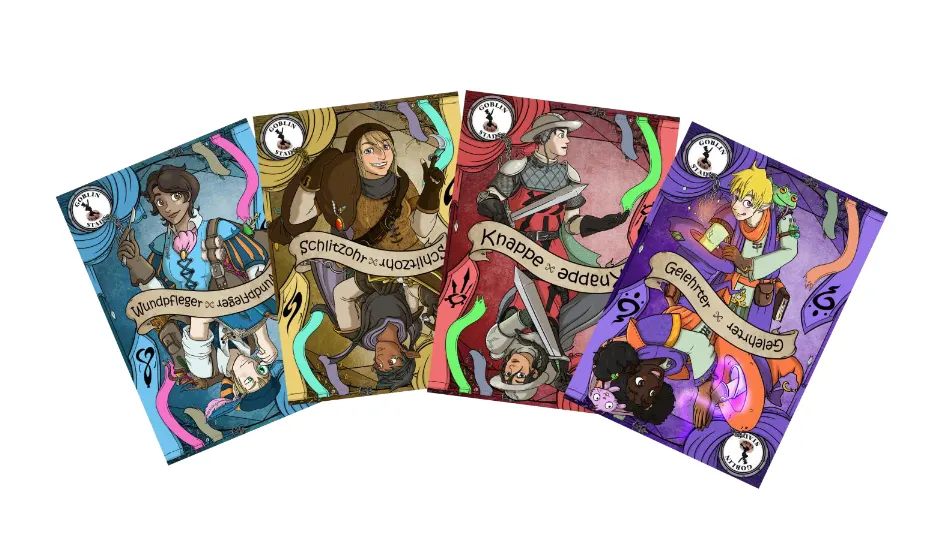
You start at level 1 and get a base equipment.
I mentioned the arena is really dark: the Mage is the only class who gets a light. The Rogue is the only class who gets keys to open certain doors. The Warrior is best suited for PvP, and the Healer is the only class who can restore hit points.
In the arena there is a counter where you get quests; again, the players can decide if they want quests in PvE or PvP.
A quest is, e.g., "What is the name of the tailor in the street 'Millers-Alley'?", up to really small hints you have to get from reading a whole piece of newspaper that's printed on a wall in some room.
When the players think they know the answer to a quest, they have to go back to the counter, and interestingly enough all of the staff there know all of the answers to all of the quests. They also offer to help and give tips if the players are not able to find even a first hint. If you give the right answer to a quest, you receive a set of random resource cards; harder quests: more resource cards.
They have a sophisticated in-house printer for playing cards to satisfy the demand and "control" the economy.
Each class has 8 different resources, and for the first 5 levels you need 5 of the same resource of your class to get a level up, which then means you get better equipment. The Mage gets a brighter light, the Healer gets more bandages, etc.
Emergent behaviour
When we first went there, we thought the kids would be exhausted and overwhelmed by chaos, but what we found was a soothing kind of coherence and flow. E.g. the whole quest receiving/giving situation is turbulent but coherent.
A lot of interesting patterns are happening outside of the playing arena. As the objective is to get a fixed set of the same resource cards, categorising and sorting your resource cards becomes part of the game. That's where parents start to engage and become the passive shopkeepers of the kids' party. You start understanding the needs of the tables closest to you and engage in more friendly trade, because you want to keep your direct table neighbours on friendly terms.
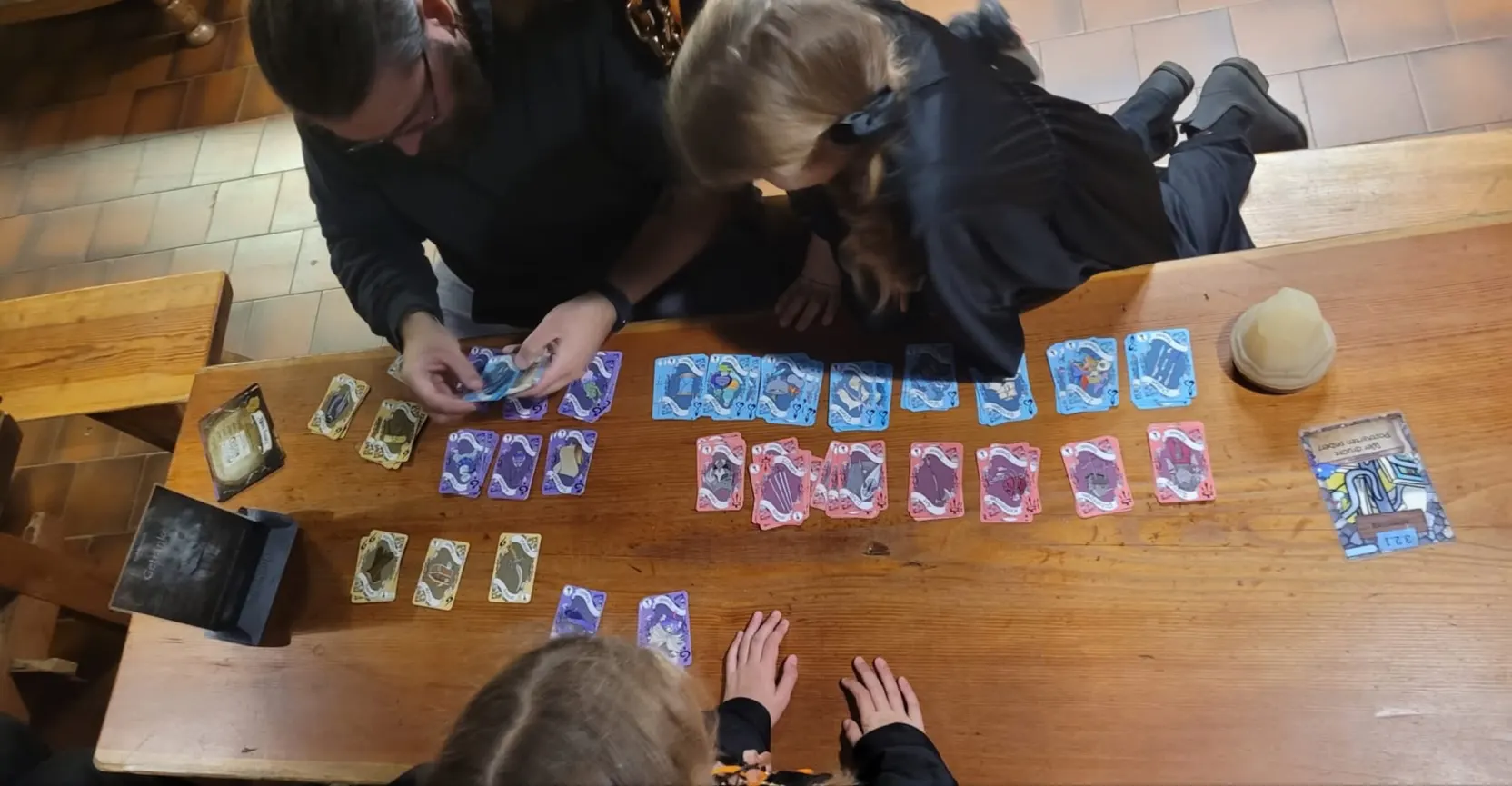
Because it is an open space and you see everyone engaged in the same activity, children and parents actually start going around and trading. The first time we went there, we had one of those isolated rooms, and almost all kids just did internal trading in the known group. But there was one kid who is notoriously extroverted and can just talk for hours, and guess who had absolutely no problem leaving the "safe space" and engaging in trading with other players? That extroverted kid.
Suddenly a personal trait becomes a valuable asset in the game.
I have also seen children start to trade and talk to adults from other groups, including children who are known to be super introverted and have problems engaging with strangers under real-life conditions.
The class selection now also becomes a meta part of the outer trading game, because if there are not a lot of Healers playing that day (if you've played an MMO, you know this problem), you have a surplus of Healer cards and no one wanting them.
So the last time my son played and I became the storekeeper, I just provided a "sorting service" for the Healer cards, where players could give me 7 or 13 unsorted Healer cards and receive 5 or 10 of the same resource card to get their level up.
Different classes having different abilities, and maybe not having a certain class in your group, also means you have to collaborate with other players, which absolutely happens, as everyone shares a foundation of "we are playing the same game".
Becoming the Enemy
Now, I mentioned that there is also a PvP area. This is where the goblins are. In the introductory session you get a little tutorial on how the combat works and that it is a respectful, fair system, which is basically a sophisticated game of catch, including an open jail where you have to stay for a certain amount of time but with the possibility of getting freed by your team if they can get around the guards.
What is not mentioned in the introductory session, and what players only realise after they have gained some levels and started to engage with the story of the arena: the goblins are other players who have reached a certain level and were offered a special training to become goblins in the game.
So instead of introducing more levels or overpowered equipment, one incentive to play and to continue is to actually become part of a different faction that has up to that point only been known as the enemy.
There is more to unpack here regarding "the enemy was one of us after all", but I'll save that for another article.
A reason to come back
Upon choosing your class you get a player card, and that player card documents your current levelling progress. You can take that class card, come back another time and continue your class journey where you left it.
That, for me, is such a friendly and wholesome way of creating a bond.
They give away a little token of remembrance that you can actually touch and look at at home, while simultaneously saying: your progress is safe with us. If you want, you can come back, but we're not forcing you into a subscription model.
I have only been to the place twice, but looking at it from a complexity point of view, it is such an inspiration.
I don't know their struggles and their obstacles and what they had to try and what didn't work, but it is quite easy to identify: what is there today has been a non-reproducible journey where people reacted to the emerging circumstances while having a coherent idea and understanding of what environment they wanted to create.
And we need more of that in business, all of it. The safe spaces to experiment, the experts who help you without robbing you of the struggle to find out yourself, the people who give without taking.
So, to close this: if you have kids in Hamburg and want to see a complex adaptive system in action, visit Goblinstadt, and if you have a business and struggle with creating an environment where beneficial emergent patterns are recognised: let's talk.
Also, a thousand thanks to Nick Drage, because I probably wouldn't have taken the time to write this down if he hadn't mentioned that I literally light up with excitement when I talk about the complexity perspective of that experience.
Comments
No comments yet.